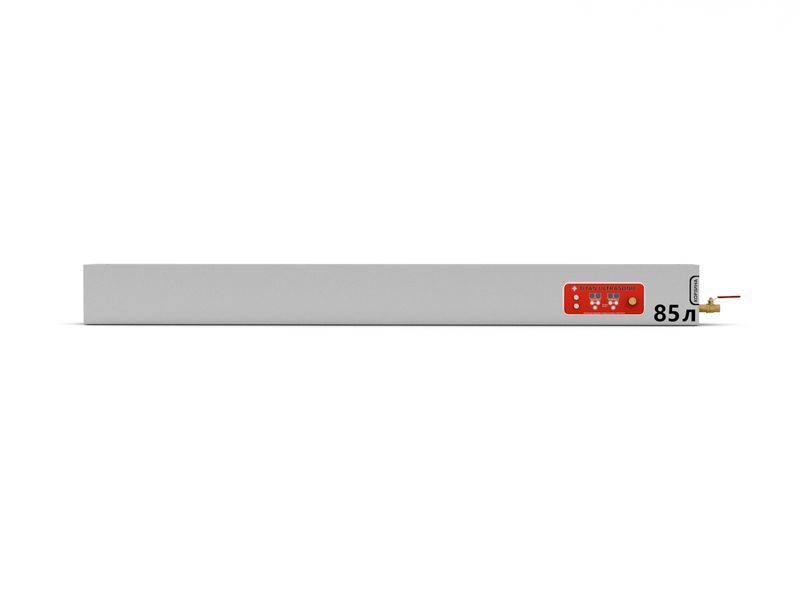
Ultrasonic Cleaner TUS-350NDF — 85 Litres, Heating, Standard
How to Choose the Right Ultrasonic Cleaner and Avoid Mistakes
[ AnchorBanner1 ]
Why the Choice of Manufacturer Matters
When you search for a professional ultrasonic cleaner, the first thing you pay attention to is a manufacturer with a strong market position. You determine which features and capabilities you need to get the job done, what level of service is offered, and what customers say after several years of use.
And you face an obvious choice: trust your money to a seller who cannot guarantee the quality of their products, or to a manufacturer who guarantees results throughout the entire service life of the cleaner.
At this point, the choice is actually simple. Either you rely on the experience of engineers who spent years bringing equipment to stable performance under real-world conditions, or you save money today to pay for defects, downtime, and repairs on a cheap Chinese tank tomorrow.
Comparing them by appearance is pointless — in terms of internals and service life, these are machines of fundamentally different classes. Any professional or business owner knows this well: every such “saving” ends up costing money, time, nerves, and customers.
What to Look for When Choosing a Semi-Industrial Cleaner
Specific Power
Now let’s talk about the most important parameter — the specific power of ultrasonic baths.
Specific power shows how much ultrasound is actually delivered per litre of solution, and therefore how “powerful” the cleaner will be against contaminants. Take two 30-litre baths — one with 300 W of ultrasound and another with 600 W — and formally both are “30 litres,” but in terms of specific power that’s 10 W/L versus 20 W/L. The difference in cleaning quality and speed will be immediately noticeable.
Practice and testing show that baths start working seriously from 20–25 W/L, the range of 25–30 W/L is considered optimal, and power around 40 W/L and above delivers confident industrial-grade cleaning without any simulation of the process.
That’s exactly why it’s important to look not just at “600 W in the specs,” but at the combination of “volume + ultrasonic power” and calculate the specific figure. Then it immediately becomes clear whether the bath will handle your task or is simply a nicely packaged heater with a faint ultrasonic background.
Defining Your Requirements Before Choosing
When choosing a semi-industrial ultrasonic cleaner, it is important to first define the task: what parts you will be cleaning, their geometry, how frequently, and what types of contamination you are dealing with.
This determines the tank size, required power, and the set of features needed. For small tools, a compact model with honest specific power is sufficient. For large assemblies and batches of parts, working volume and tank dimensions become critical.
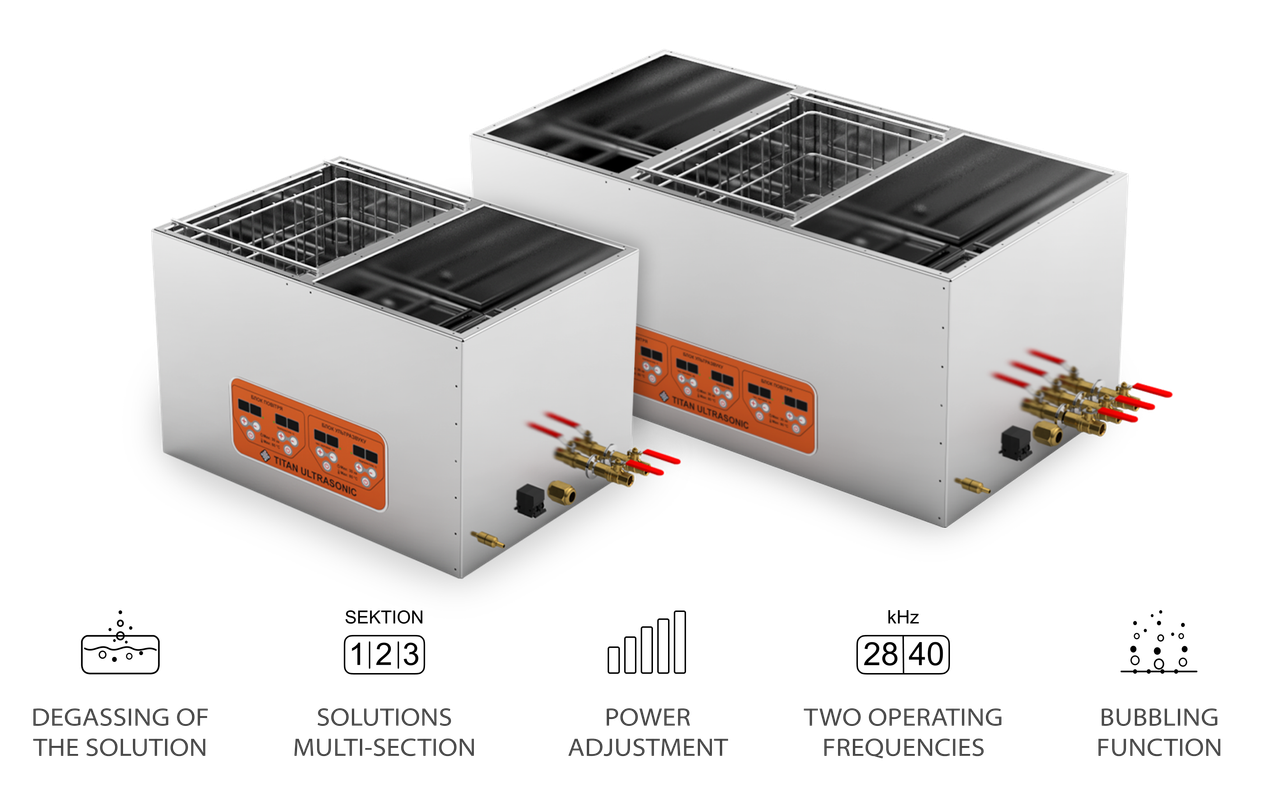
Next, focus not on marketing language but on specifics: is there degassing, power adjustment, dual-frequency operation, a well-designed drain, and a proper basket? Warranty coverage, repair availability, and spare parts access also play a significant role — without these, even the “best” cleaner becomes a consumable.
[ AnchorVideo1 ]
Questions to Ask the Manufacturer Before Buying
Three key questions:
- How does this equipment perform in real-world use? Ask not for general statements but for specific examples: where are these cleaners installed, how many years have they been running, and under what load. Real case studies matter more than any advertising formula.
- What happens if the cleaner breaks down after a year? Find out who handles repairs, whether there is a spare parts inventory in Ukraine, and how long diagnostics and restoration typically take. A professional service handles typical failures within a few days and at a reasonable cost — the price of one or two transducers, not half the cost of a new bath. A sincere and specific answer to this question regarding timelines and costs says a great deal about the manufacturer’s level.
- What parameters do you recommend for my specific tasks? Describe your use case and see whether the manufacturer asks clarifying questions about volume, contamination type, and operating schedule. If they simply “sell litres” without digging into the details, that is a warning sign.
A Ukrainian Manufacturer for Professional Cleaning
Why Titan Techniks
Titan Techniks is a manufacturer you can talk to not about “product range positions,” but about solving your specific problems. The Titan Ultrasonic engineering team has spent many years developing ultrasonic cleaners specifically for Ukrainian operating conditions. Our clients include auto repair shops, industrial enterprises, and even medical institutions.
We don’t sell “a box with a pretty label” — every bath is assembled, configured, and commissioned as a working tool. The company does not hide behind distributors: there is a modern production facility, experienced specialists, and reliable service support. For a business owner, this is not an abstract brand but a dependable partner who takes responsibility and guarantees excellent results.
Titan Techniks Ultrasonic Cleaner Classification
We developed our product line to cover a wide range of tasks — from a dental office to a production floor with continuous-flow cleaning — and today we can identify three distinct equipment classes.
Semi-Industrial Ultrasonic Cleaners
Titan Techniks semi-industrial models are designed for daily use in service workshops, clinics, and repair facilities where stable cleaning and compact dimensions are essential. These are baths ranging from 3 to 100 litres with a frequency of 40 kHz, honest specific power, heating, a timer, an LCD display, and optional degassing and power adjustment functions. They are chosen wherever professional results are needed without the size and energy consumption of large industrial equipment.
Industrial Ultrasonic Cleaners
Titan Ultrasonic industrial cleaners are the “heavy-duty” class: volumes from 30 to 10,000+ litres, reinforced housings, increased ultrasonic power, and extended functionality. This segment uses dual-frequency 28/40 kHz solutions, bubbling, filtration, oil traps, lifting tables, rotary mechanisms, and other options for continuous operation in workshops and on production lines. These units are built for serious contamination — carbon deposits, oil, process residues — and multi-shift operation.
Multi-Section Ultrasonic Cleaners
Titan Techniks multi-section ultrasonic cleaners — thanks to years of experience and the unique requirements of our clients, we have created innovative solutions for your technological breakthrough.
This is a new standard in the industry: compact benchtop units with a volume starting from 3 litres per section deliver flawless results. Large industrial systems up to 10,000 litres transform the approach to conveyor processing, combining separate cleaning stages into a single, fully automated line and turning complex multi-step cleaning into a predictable process.
Different sections can be used sequentially for degreasing, ultrasonic treatment at one or two frequencies, rinsing, passivation, or final washing. These are comprehensive systems in which multiple baths are integrated into a single process line, making it possible to achieve a truly perfect result.
Such cleaners are used wherever a structured sequence of operations and consistent repeatability are essential: fuel injection system repair, precision parts manufacturing, and medical or laboratory processes.
How Ultrasonic Cleaning Works
The Principle of Ultrasonic Cavitation
The operating principle of an ultrasonic cleaner is based on the phenomenon of acoustic cavitation. The ultrasonic transducer transmits vibrations at a frequency of 28,000 or 40,000 cycles per second through piezoelectric converters, which create alternating zones of high and low pressure in the working solution.
In the low-pressure zones, billions of microscopic bubbles form. As each one collapses, it produces a micro-impact with localised pressure on the part surface (up to 1,000 atmospheres) and a temperature spike (up to 5,000 °C) — enough to literally “knock off” contaminants from any surface.
The key advantage of ultrasonic cleaning is that it provides volumetric cleaning of the part, not just treatment of accessible surfaces. As a result, the working solution penetrates threaded connections, closed channels, capillary gaps, and porous areas.
Oil, carbon deposits, flux, solder paste, biological, and corrosion residues are removed without harsh mechanical impact on the surface, which is critically important for precision fits, coatings, and delicate components.
Additional Features Available in Semi-Industrial Ultrasonic Baths
Degassing is a preparatory mode that runs before the main cleaning cycle. Fresh water or solution contains a lot of dissolved air, which prevents cavitation from reaching its full potential and noticeably weakens the ultrasound. Over 5–10 minutes, degassing drives air bubbles out of the liquid and removes the air film from the surface of the part.
As a result, cavitation activity increases by 20–30%, the solution works evenly across the entire surface, and you get a cleaner result in less time.
Power adjustment is like fine-tuning a tool — something most basic cleaners simply lack. It allows you to work not always at full power, but to adjust ultrasonic intensity for a specific task: reduce to 20–50% for delicate items and increase to maximum for heavy contamination.
In gentle mode, you can safely clean jewellery with set stones, thin electronic circuit boards, optical elements, and sharp tools — cutting edges won’t dull or round off. When you need to remove carbon deposits, oil, flux, or process residues, power is returned to nominal level and you get full industrial-grade cleaning with no compromise on results.
Dual-frequency mode gives you the ability to switch between 28 and 40 kHz depending on what is in the bath. The lower frequency of 28 kHz produces more aggressive cavitation with larger bubbles — it handles dense contamination well: carbon deposits, engine oil, and heavy residues on metal parts.
The higher frequency of 40 kHz works more gently and precisely — smaller bubbles, softer action, which is important for electronics, optics, and coated parts. In essence, instead of a single-purpose cleaner, you get two operating modes in one unit and no longer have to compromise between “clean thoroughly” and “avoid damage.”
Which Features Do Professionals Choose?
The experience of our clients has shown that a combination of two features has become an essential setting for quality cleaning.
Deep Clean (Degassing + 2 Frequencies)
In medicine, where perfect and uniform cleaning of medical instruments is required, with the option of two-stage processing at low and high frequency.
For auto repair shops and production facilities that need to combine aggressive cleaning of heavy contamination with a gentle mode for parts requiring special handling conditions.
For electronics service centres: remove air from the solution for maximum cavitation efficiency and gently tune the ultrasonic “intensity” for different boards and components.
Is it possible to achieve perfect cleaning without compromise? Yes — thanks to the Full Control series, this has become a reality.
(Degassing, 2 Frequencies, Power Adjustment)
guarantees maximum performance and consistent results. This is the perfect solution for professional cleaning of any item — from delicate instruments to industrial parts. The ideal choice for laboratories, engineering companies, and high-tech production facilities.
[ AnchorVideo2 ]
Applications of Semi-Industrial Cleaners
Semi-industrial ultrasonic cleaners are used wherever stable, repeatable cleaning results are required under daily workloads.
Auto Repair, Diesel Service, Engine and Transmission Repair
Cleaning of manual gearboxes (MT), automatic transmissions (AT), dual-clutch transmissions (DCT/DSG), robotised gearboxes (AMT), continuously variable transmissions (CVT), crankcases, gears, synchronisers, shift forks, bearings, torque converters, planetary gear sets, friction clutches, valve bodies, mechatronics units, servo drives, steel belts or CVT chains, carburettors, injectors, nozzles, fuel system components, and oil and fuel pump passages. Ultrasound removes carbon deposits, oil, and lacquer deposits without damaging precision mating surfaces.
Medicine and Dentistry
Pre-sterilisation cleaning of surgical instruments, dental handpieces, mirrors, forceps, endodontic instruments, and cassettes. The goal is consistent removal of biological contamination and residual compounds before subsequent disinfection and sterilisation.
Electronics and Service Centres
Cleaning of circuit boards and modules from flux and solder paste, rinsing boards after moisture damage, cleaning connectors and contact groups. Gentle modes and correctly selected solutions are used to preserve tracks and coatings.
Machining and Small-Batch Production
Removal of cutting fluids, preservation grease, abrasive residues, and corrosion products after turning, milling, and grinding of various assemblies and parts. Applied before inspection, assembly, painting, or coating.
Beauty Industry and Tattoo Studios
Cleaning of metal instruments, machine attachments, grips, and tattoo equipment components. Preserving the geometry of working edges and surface quality during regular repeated cleaning is essential.
Why a Ukrainian Manufacturer Matters
Problems with Cheap Chinese Cleaners
According to market estimates, over the past 10 years up to 80–90% of ultrasonic cleaners in Ukraine have been disposable Chinese units imported as “suitcase imports” and sold under dozens of different brand names.
Their power specifications most often fall short of even 15–20 W/L against the acceptable 25–40 W/L, and the bath metal thickness instead of an honest 0.45–0.6 mm turns out to be 0.3–0.4 mm. Sanitary certificates are absent in most cases, and the “warranty” is limited to 3–6 months with no clear service support or spare parts access.
What a Ukrainian Manufacturer Offers
A Ukrainian manufacturer offers an alternative: real, not just stated, 30–40 W/L, controlled frequency, a clear transducer and housing service life. The equipment can be officially used in medical facilities, pass inspections, and be properly documented. Most importantly for business — the service department and spare parts inventory are located within the country, reducing repair times from weeks or months to a matter of days and making cleaner operation predictable.
Titan Ultrasonic (Titan Techniks LLC)
Titan Ultrasonic (Titan Techniks LLC) is a Ukrainian manufacturer with a full production cycle, in-house R&D, and a service centre in Zaporizhzhia:
- Sanitary certificates
- SS304 stainless steel housings
- Real, not just rated, power output
- Warranty and in-country service support
- Custom solutions available
Frequently Asked Questions from Our Clients
Is a special cleaning solution required?
Technically, an ultrasonic cleaner can operate with plain water, but this is an inefficient use of the equipment. The optimal option is distilled water combined with a specialised cleaning concentrate.
How long will a Ukrainian-made ultrasonic cleaner last?
With correct operation, the service life of piezoelectric transducers averages 1–3 years without noticeable loss of power. The semi-industrial series comes with a 6-month warranty and post-warranty service support is available.
How do Titan Techniks cleaners differ from Chinese cleaners?
Chinese baths frequently have a gap between stated and actual parameters, with real working power delivering around 10–15 W/L, whereas Titan Techniks semi-industrial cleaners of the same 30-litre volume deliver a guaranteed 30–40 W/L. Chinese models are typically built from thin “stainless steel” of 0.3–0.4 mm, while Titan Techniks baths are assembled from SS304 steel. Add to this sanitary certificates, full standard equipment, and service and spare parts availability within Ukraine.
What tank volume should I choose?
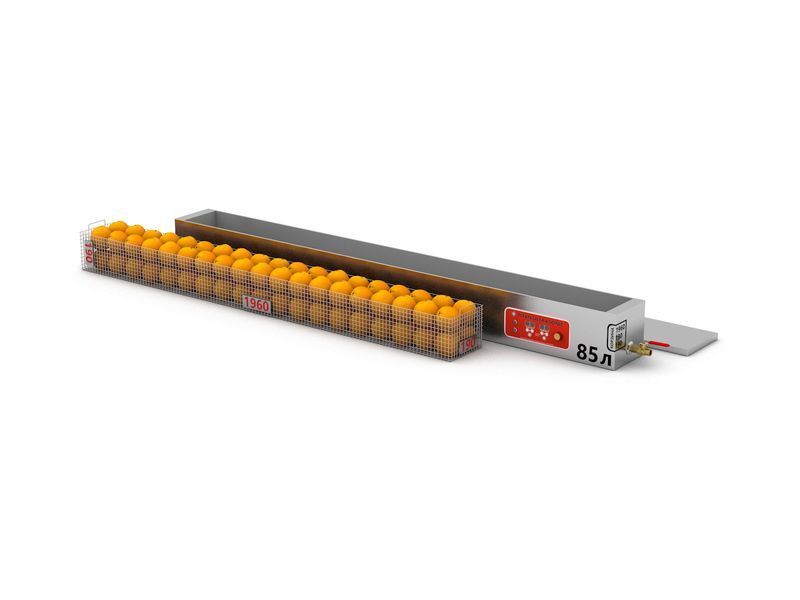
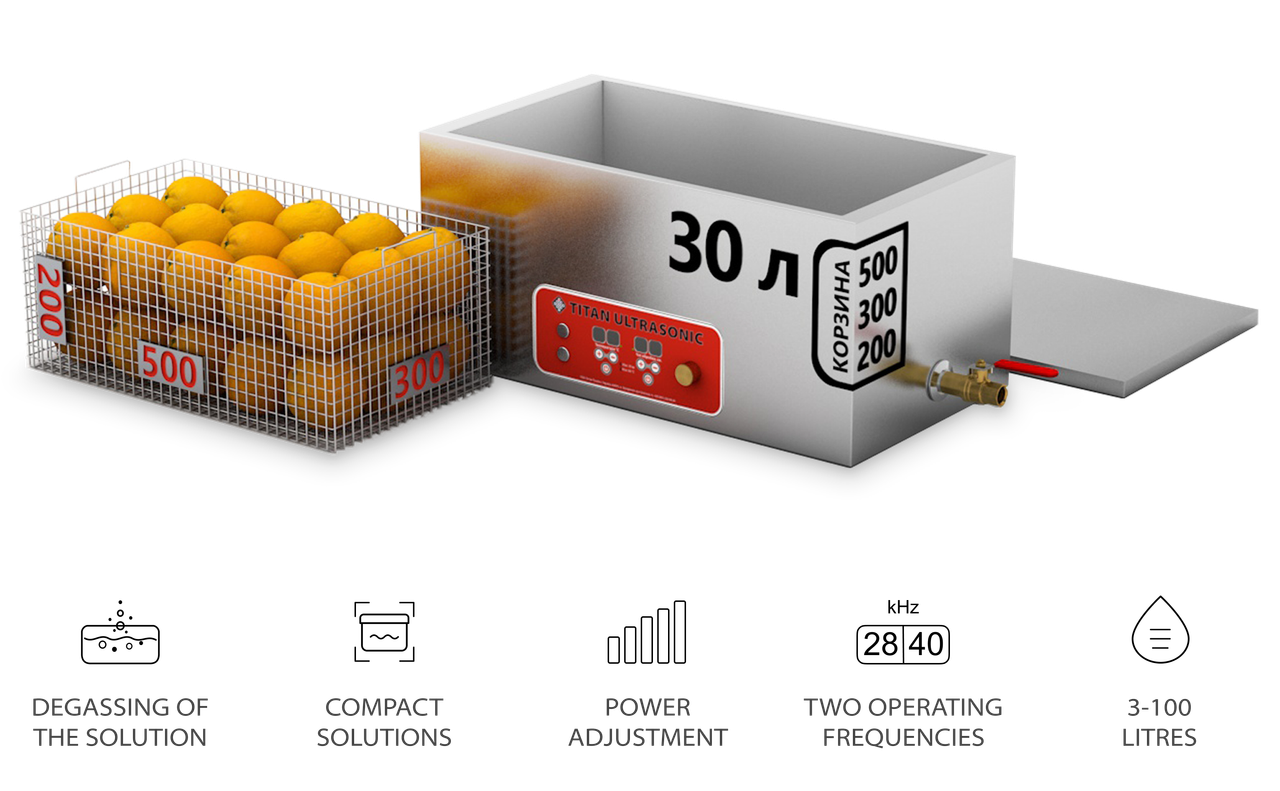
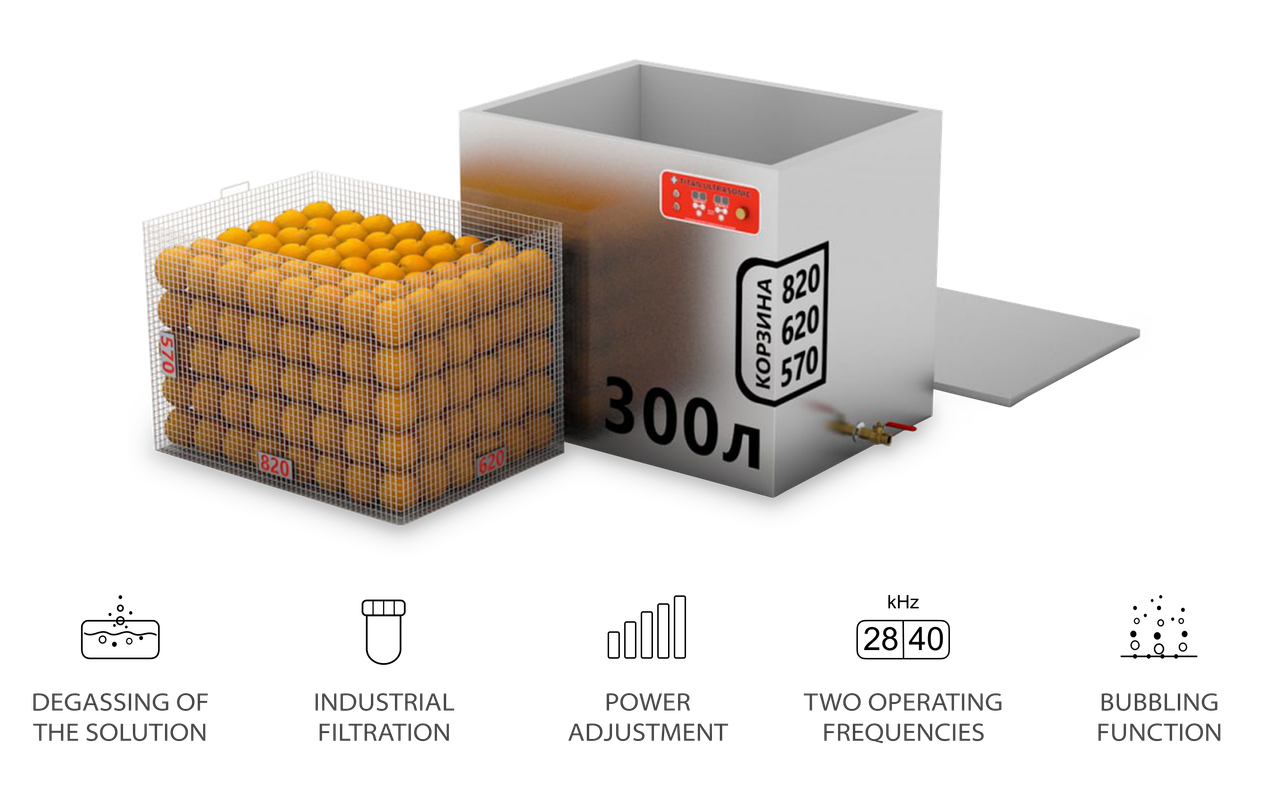
The primary consideration should not be the stated litrage but the actual working chamber dimensions. The bath is selected based on the dimensions of the items you plan to immerse: length, width, and height, accounting for the basket and the required clearance around the perimeter.
🍊
We measured the basket in oranges — and it works better than any table.
Yes, in oranges, not millimetres.
Because you’ve definitely held an orange in your hand and know exactly how big it is.
We’ll be honest: figures like “470 × 270 × 180 mm” don’t really spark the imagination.
An orange gives a real sense of scale that everyone understands immediately.
One glance at the photo — no mental ruler required, you can see right away whether your part will fit or not.
Are Titan Techniks cleaners suitable for medicine and dentistry?
Yes. The cleaners are supplied with a full set of sanitary certificates required for the use of ultrasonic equipment in medicine, dentistry, and cosmetology within Ukraine.
Technical Specifications of TUS-350NDF
| Parameter |
Value |
| SKU |
TUS-350NDF |
| Name |
Semi-industrial ultrasonic cleaner |
| Manufacturer |
Titan Techniks |
| Equipment Type |
Semi-industrial ultrasonic cleaners |
| Series |
Titan Ultrasonic |
| Ultrasonic Cleaning Power (W) |
2125 |
| Heating Power (W) |
2325 |
| Country of Origin |
Ukraine |
| Basket Length (mm) |
1960 |
| Basket Width (mm) |
190 |
| Basket Height (mm) |
190 |
| Volume (L) |
85 |
| Tank Length (mm) |
2050 |
| Tank Width (mm) |
200 |
| Tank Height (mm) |
200 |
| Power Adjustment |
No |
| Degassing (Pulse Mode) |
Yes |
| 28/40 kHz (Dual Frequency) |
Yes |
| Operating Frequency (kHz) |
40 |
| Additional Frequency (kHz) |
28 |
| Bubbling |
No |
| Heating Temperature |
20 – 80 °C |
| Timer |
Yes |
| Power Supply |
220 V, 50/60 Hz |
| Material |
Stainless steel SS304, SS316 |
| Weight (kg) |
75 |
| Warranty (months) |
6 |
| Basket |
Yes |
| Power Cable |
Yes |
| Drain Valve |
Yes |
| Product Passport |
Yes |
| Certificate |
Yes |
| Number of Sections |
1 |
| Voltage (V) |
220 |
| Lid |
Yes |
| Controls |
Electronic |
| Display |
Yes |
| Model Release Date |
2026 |
| Service Life |
2 years |
| Multilingual Interface |
No |
| Repairability |
Medium |