We deliver across Ukraine. Choose a convenient delivery option; if needed, our manager will confirm lead times, costs, and shipping details with you.
Delivery area
Delivery throughout Ukraine
We ship orders to all regions of Ukraine. Depending on the option you choose, postal services and door-to-door courier delivery are available.
Please note: on the official TitanTech page it is stated that delivery is carried out only after prepayment. Learn more
Nova Poshta
Delivery via Nova Poshta (1–3 days)
You can receive your order at a branch, in a parcel locker, or choose courier delivery to your address.
To a branch — from 80 UAH.
To a parcel locker — from 80 UAH.
By courier (door-to-door delivery to: street, house, plot, postal code) — from 110 UAH.
You can track your shipment on the website using the declaration number: www.novaposhta.ua.
Ukrposhta
Ukrposhta Standard (1–6 days)
Orders can also be delivered via Ukrposhta, with pickup at a branch, parcel locker, or by courier.
To a branch — from 75 UAH.
To a parcel locker — from 75 UAH.
By courier (door-to-door delivery to: street, house, plot, postal code) — from 100 UAH.
You can track your shipment on the website using the declaration number: www.ukrposhta.ua.
If the goods are lost
What to do if the shipment is lost
If your shipment has not been delivered or has been lost in transit, please have your declaration number or order number ready so we can resolve the issue quickly.
Nova Poshta: hotline 0-800-500-305, provide the declaration number.
Ukrposhta: visit a branch and provide the declaration number.
Courier delivery: contact TitanTech and provide your order number.
TitanTech guarantee: in case of confirmed loss, the company guarantees a refund or reshipment of the goods.
Contacts
Contact for delivery questions
If you need to clarify lead times, shipping method, or order status, please use the contact details below.
Email: titantex2017@gmail.com
Phone: +38 077 750 70 77
Business hours: Mon–Fri 9:00–17:00
Payment Methods
Choose the most convenient payment option for your order. For some payment methods, a manager may additionally уточнить details, payment information, and processing terms.
monobank
Installment Payment from monobank
You can place an order using the “monobank Installment Purchase” service. The payment is divided into equal monthly installments, and the first payment is made at the time of purchase.
Service provider: JSC “UNIVERSAL BANK”.
NBU license: No. 92.
Number in the state register of banks: No. 226.
Minimum installment amount: 1 UAH.
Maximum installment amount: 400,000 UAH.
Real annual interest rate: 0.000001%.
Available term: from 3 to 25 payments.
Repayment procedure: equal monthly payments.
Information about the essential product characteristics and warnings is available on the website chast.monobank.ua.
Customer requests regarding orders and payments are processed on a mandatory basis. Product returns are possible within 14 days from the date of purchase if there are no signs of use, and warranty obligations for new goods are provided in accordance with the law and the terms of sale.
Online payment
Card Payment
You can pay for your order online with a Visa or Mastercard bank card on the website. After your order is confirmed, you will be redirected to a secure payment page to complete the payment.
Cards issued by Ukrainian and foreign banks are accepted if the transaction is supported by the issuing bank.
Payment is processed through a secure payment interface.
Confirmation of successful payment is sent after the transaction is completed.
Online payment acceptance on the business side may be processed through mono acquiring; mono materials state that payouts for transactions are usually credited to the main UAH account of a sole proprietor or legal entity on the next day.
Bank transfer
Payment to the Bank Details of Titan Technics LLC with VAT (+20%)
For legal entities and clients who require non-cash settlement, payment by invoice to the bank details of Titan Technics LLC is available.
The invoice is issued by the manager after the order composition is agreed upon.
Shipment is made after the funds are credited to the settlement account, unless otherwise agreed separately.
If necessary, an invoice, shipping documents, and accompanying documentation are provided.
Current bank details, payment purpose, and the package of documents are provided by the manager when placing the order.
For entrepreneurs
Payment via Sole Proprietor Account with VAT (+5%)
If necessary, payment to the bank details of a sole proprietor is possible. This option is suitable for clients who find it more convenient to make payment to a business account.
The sole proprietor’s bank details are provided by the manager after the order is confirmed.
Before payment, the amount, payment purpose, and product availability are clarified.
Closing documents are provided within the available form of settlement.
Before making payment, it is recommended to wait for order confirmation so that the manager can fix the current price, configuration, and delivery terms.
Upon receipt
Cash on Delivery via Postal Service (for Goods up to 5,000 UAH)
You can place an order with payment upon receipt at a postal service branch. Before shipment, the manager confirms the order, recipient details, and the final amount payable.
Payment is made at the carrier’s branch upon receipt of the shipment.
Carrier services and the cash on delivery fee are paid according to the rates of the selected delivery service.
Prepayment may be required before shipment if the product is supplied on request, has large dimensions, or is manufactured individually.
Please check the integrity of the packaging and the completeness of the goods upon receipt.
Warranty
We provide a warranty for equipment provided that the rules of operation, installation, and maintenance are followed. Depending on the type of equipment, the warranty period ranges from 3 to 36 months.
General Terms
Warranty Period for Equipment
The warranty applies to equipment manufactured and supplied by our company and is valid provided that the requirements specified in the operating instructions, technical documentation, and accompanying documents are met.
The warranty period depends on the specific model, purpose, and type of equipment and may range from 3 to 36 months. The exact warranty period is specified in the invoice, contract, specification, product passport, or product page.
Start Date
When the Warranty Begins
The warranty period starts from the date the equipment is transferred to the buyer unless otherwise specified in the supply contract.
From the date of shipment or signing of shipping documents.
From the date of commissioning — for equipment that requires installation and setup.
If applicable — according to the signed commissioning certificate.
Coverage
Scope of Warranty Obligations
During the warranty period, we ensure the elimination of defects caused by the manufacturer, as well as the repair or replacement of faulty components based on diagnostic results.
Free diagnostics of warranty cases.
Repair or replacement of defective parts and assemblies.
Full equipment replacement — if repair is impossible or impractical.
Validity Conditions
When the Warranty Remains Valid
The warranty is valid only if the equipment is used correctly and all manufacturer requirements are followed.
Operation: the equipment must be used strictly for its intended purpose and within permissible load conditions.
Connection: requirements for power supply, grounding, installation, and environmental conditions must be observed.
Maintenance: scheduled maintenance must be performed on time if specified in the documentation.
Service: repair, adjustment, and modifications to the design are permitted only by authorized specialists.
Exclusions
What Is Not Covered by Warranty
Mechanical damage, signs of impact, drops, or improper transportation.
Failures caused by violation of operation, installation, or storage rules.
Damage due to power surges, lack of grounding, or improper connection.
Natural wear of consumables, seals, filters, lamps, nozzles, and other components with limited service life.
Unauthorized repair, opening, modification, or third-party interference without approval.
Procedure
How to Make a Warranty Claim
If a malfunction is detected, stop using the equipment and contact the service department or your company manager. If possible, record a video with comments describing the issue.
Provide the equipment model and serial number.
Prepare documents confirming the purchase.
Briefly describe the malfunction and the conditions under which it occurred.
After the request, the equipment may be sent to a service center for diagnostics.
Important
Warranty Period Clarification
The warranty period varies for different categories of equipment. Depending on technical characteristics, design, and operating conditions, the warranty may range from 3 to 36 months.
The exact warranty period is specified individually for each model.
Priority is given to the data specified in the supply contract and technical documentation.
Warranty obligations terminate after the established warranty period expires.
New review or comment
Industrial Ultrasonic Cleaner TUS-99PRDF5545ST3 for Cleaning Large Batches of Parts in Workshops and Manufacturing Facilities
How to Choose the Right Industrial Ultrasonic Cleaner Without Making a Mistake
[ AnchorBanner1 ]
Why the Manufacturer Matters in Industry
When you are looking for an industrial ultrasonic cleaner, you are choosing not just a “large tank,” but a key element in the production chain, one that affects lead times, cost, and the stability of the entire operation.
Here, what matters is not how many liters are in the specification sheet, but who designed the equipment, what its real service life is, and how it behaves in multi-shift operation.
In practice, this is a choice between investing in a proven system with clear service support or buying an anonymous large tank without a real usage history and proper support. In the first case, you control the process; in the second, you are constantly playing a lottery.
In the industrial segment, it is especially clear that systems with similar outward design can differ significantly in configuration, power, reliability, and automation level.
Saving on the manufacturer’s engineering, steel quality, and electronics always comes back as downtime, emergency repairs, and defective output.
That is why the main selection criterion is a combination of factors: the manufacturer’s experience, completed projects, a high degree of adaptation to your specific tasks, and a willingness to take responsibility for cleaning results throughout the entire service life.
What to Pay Attention to When Choosing an Industrial Cleaner
Power Density and Tank Geometry
For industrial tanks, power density becomes critical. It is not enough to simply “fill a large tank with ultrasound” — you must ensure uniform cavitation throughout the entire volume, including the area with the highest load of parts.
If you take two 500-liter tanks with the same form factor, but one has 10 kW of ultrasound and the other 20 kW, then formally these are “two identical industrial cleaners.” In practice, these tanks have power densities of 20 W/L versus 40 W/L — the difference in cleaning quality and speed will be enormous, especially with a fully loaded basket and in continuous flow operation.
Practice shows that serious industrial cleaning is provided by tanks from 25–30 W/L, the optimal range is 30–35 W/L, and 40 W/L and above already delivers confident performance with the toughest contaminants and no compromises.
It is the combination of volume, power, and correct emitter layout that determines whether the system will really perform shift after shift.
The Cleaner’s Place in the Technological Chain
To choose an industrial unit, you need to clearly define:
- How clean do you want the part to be, and at what point in the technological chain will the cleaner be installed?
- What sequence of cleaning stages is required in your process?
- For which operations do you need to ensure the next cleaning stages? (preliminary cleaning before machining, in-process washing, surface preparation for painting, galvanizing, or final cleaning before assembly)
The answers determine the required volume, the type and number of sections, the solution replacement frequency, and the required set of options:
Power control
2 frequencies
Degassing
Bubble aeration
Filtration
Oil separator
Lifting and rotary mechanisms
Lid with gas struts
Automated loading and unloading
It is important to look not at abstract “liters and kilowatts,” but at the specifics: how drainage and filtration are arranged, whether modernization is possible, temperature and time control, dry-run protection, degassing mode, and dual-frequency operation. All of this determines not only cleaning quality, but also real operating costs.
[ AnchorVideo1 ]
Questions to Ask the Manufacturer Before Purchase
Three key questions:
Where are such systems already operating, and in what mode? Ask for examples of completed projects: the industry, tank volume, loading mode, how many years the cleaner has operated, and what modifications were required. Real cases and feedback from plant engineers say more than any marketing formula.
How is service organized, and how long will the line be stopped in a typical failure? Find out whether there is a service center in Ukraine, whether there is a stock of key components (emitters, boards, heaters, pumps), and what the real response times are for industrial facilities. For a serious manufacturer, the norm is repairing a typical fault in a few days, not waiting weeks for spare parts. An honest and specific answer to this question about timing and cost very clearly shows the manufacturer’s level.
What set of options is needed specifically for your process? Describe your cycle: maximum part size, type of contamination, required cleaning level, and planned batch volume. An important sign is how deeply the manufacturer understands the details and whether they offer solutions for line layout, chemistry selection, and operating modes — or simply sell a “standard tank” without adapting it to your production.
Ukrainian Manufacturer for Industrial Tasks
Why “Titan Techniks”
“Titan Techniks” is a manufacturer that builds systems around your technological tasks rather than selling ready-made boxes under keyword-driven product names. The Titan Ultrasonic engineering team designs and manufactures industrial tanks and multi-stage lines with real Ukrainian workshop conditions in mind: heavy contamination, unstable power supply, limited space, and strict safety requirements.
Each industrial cleaner is a project: from selecting the tank volume and configuration to designing fixtures, adjusting operating modes, and commissioning on site. For the production owner, this means not just equipment delivery, but a partnership: help integrating the system into an existing line, staff training, fast service, and the ability to upgrade as the workload grows.
How Ultrasonic Cleaning Works
Principle of Ultrasonic Cavitation
The operating principle of an ultrasonic cleaner is based on acoustic cavitation. The ultrasonic emitter transmits vibrations at a frequency of 28,000 or 40,000 times per second to piezoelectric transducers, which create alternating high- and low-pressure zones in the working solution.
In the low-pressure zones, billions of microscopic bubbles are formed. When they collapse, each one produces a micro-impact with local pressure on the part’s surface of up to 1,000 atmospheres and a temperature jump of up to 5,000 °C — enough to literally “knock off” contaminants from any surface.
The key advantage is volumetric cleaning of the part, not just treatment of accessible surfaces. As a result, the working solution penetrates threaded connections, closed channels, capillary gaps, and porous areas.
Oil, soot, flux, biological deposits, and corrosion residues are removed without harsh mechanical action, which is critical for precision fits, coatings, and delicate components.
Classification of Titan Techniks Ultrasonic Cleaners
The Titan Ultrasonic line is designed to cover the entire customer journey: from a single semi-industrial cleaner to a fully automated multi-stage line for a large factory.
Semi-Industrial Ultrasonic Cleaners
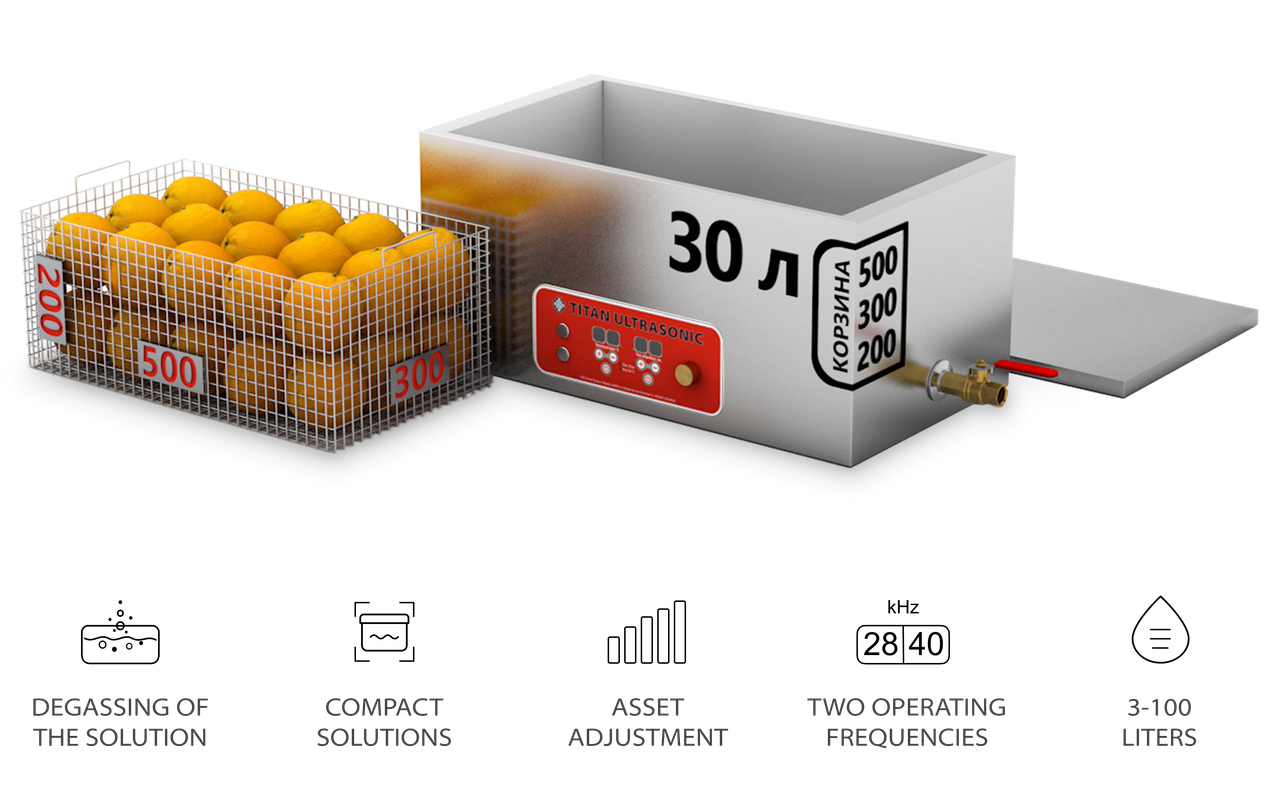
Titan Techniks semi-industrial models are designed for daily operation in service centers, clinics, and workshops. These are tanks from 3 to 100 liters with a 40 kHz frequency, genuine power density, heating, timer, LCD display, and, when needed, degassing, power control, and dual-frequency operation. They are chosen where professional results are needed without a large unit size or high energy consumption.
Industrial Ultrasonic Cleaners
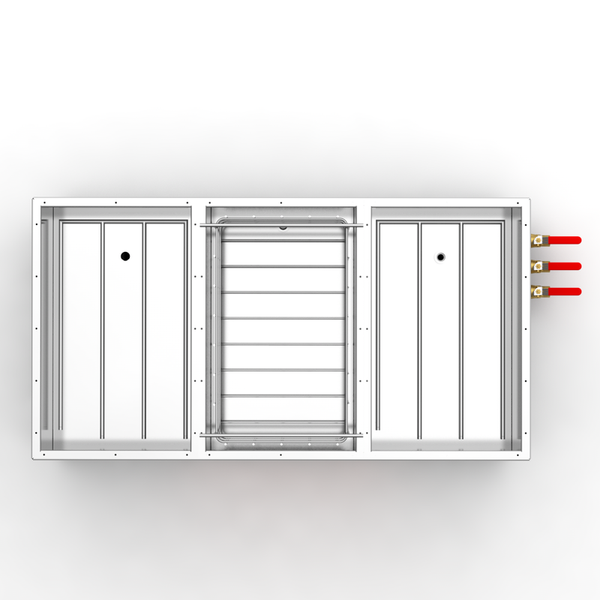
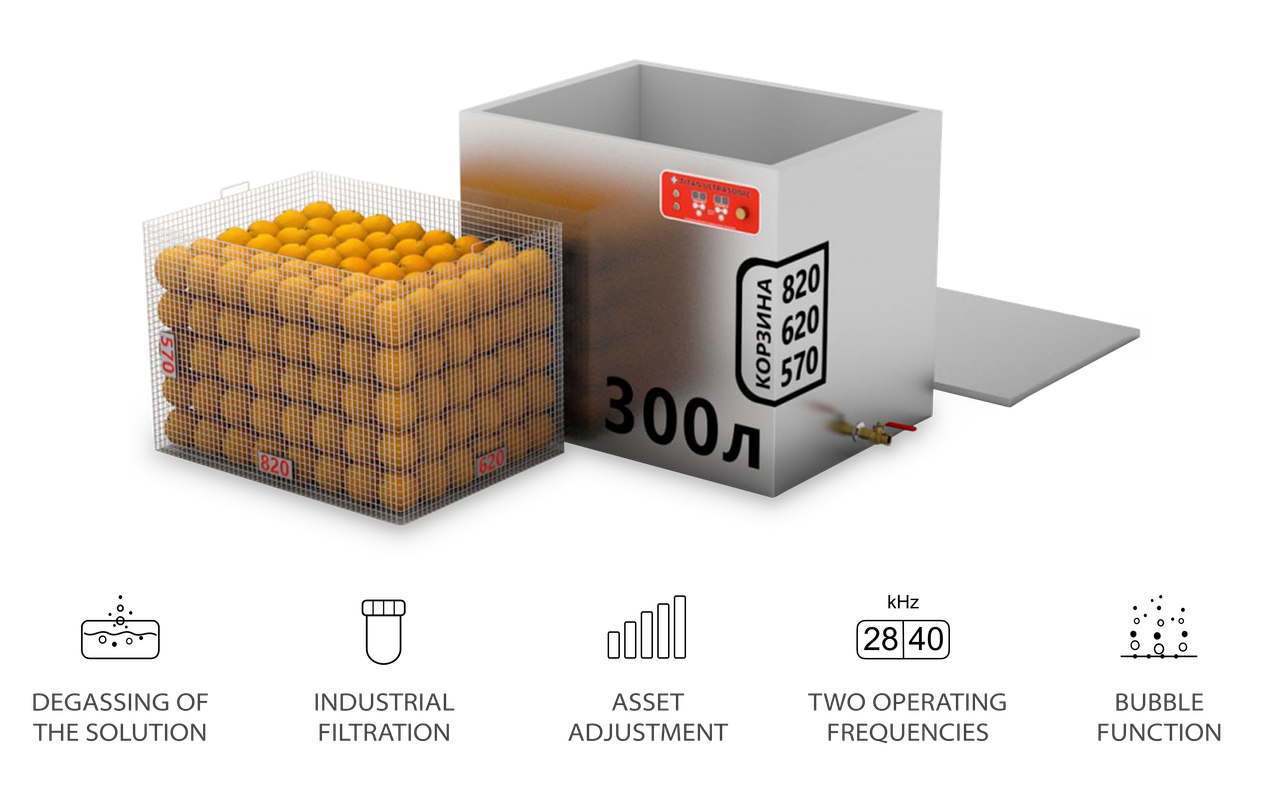
Titan Ultrasonic industrial cleaners are the heavy-duty class: volumes from 30 to 10,000+ liters, reinforced SS304 / SS316 stainless-steel bodies, higher ultrasonic power, and expanded functionality. Dual-frequency 28/40 kHz solutions, bubble aeration, filtration, oil separators, lifting tables, and rotary mechanisms — everything for continuous operation in workshops and production facilities. These systems are designed for serious contamination — soot, oil, technological residues — and multi-shift operation.
Multi-Stage Ultrasonic Lines
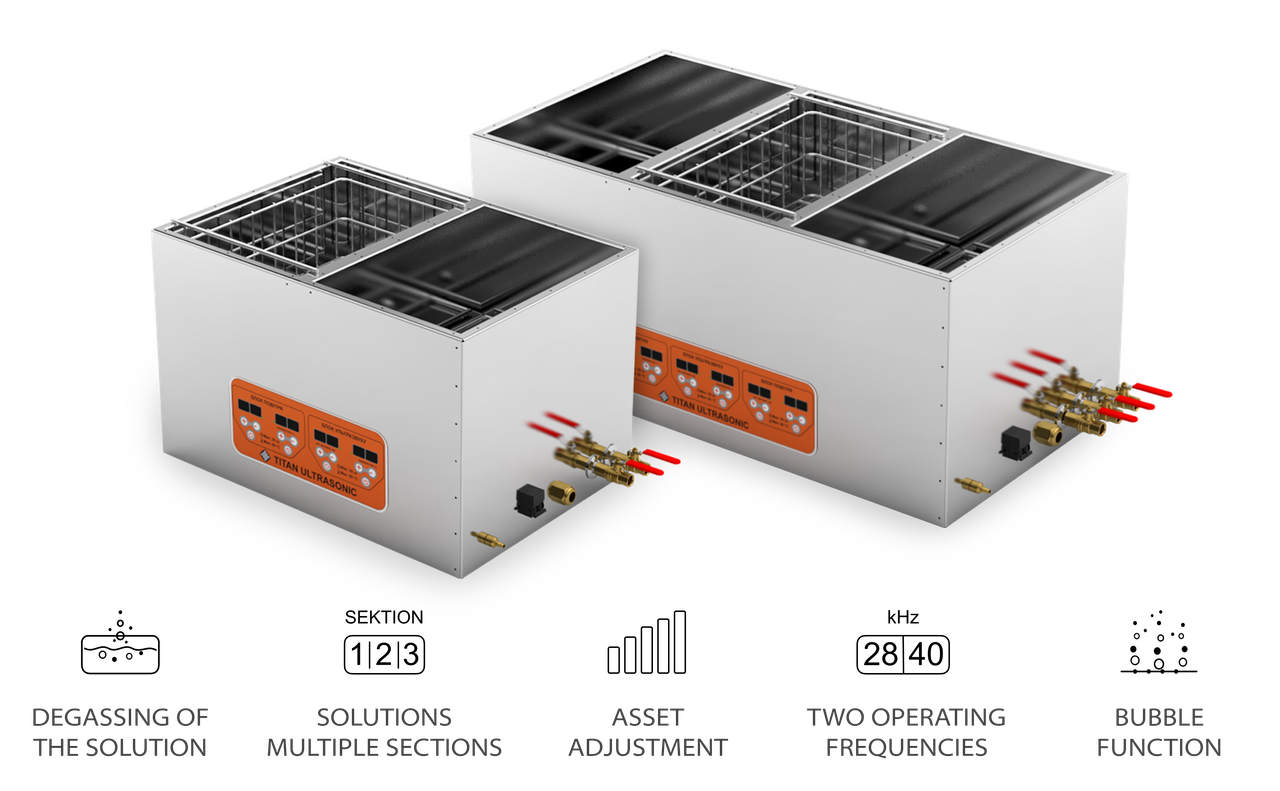
Titan Techniks multi-stage ultrasonic cleaners are a level where ultrasound stops being a separate operation and becomes part of a fully structured process line. Several tanks are combined into one system where degreasing, ultrasonic cleaning at one or two frequencies, rinsing, passivation, and final washing are carried out in sequence.
Compact solutions are suitable for laboratories and small-batch production, while large systems up to 10,000 liters make it possible to organize conveyor-based processing of batches with defined throughput and repeatability. This format is for those who need guaranteed cleanliness with large volumes and strict quality requirements.
Additional Functions of Industrial Tanks
Bubble Aeration
Bubble aeration is air injection from below through perforated pipes, creating intensive circulation of the solution and helping remove loose contaminants from the part surface more quickly. In combination with ultrasound, this increases cleaning speed and reduces the risk of stagnant zones in large tanks.
Filtration and Oil Separators
Filtration systems and oil separators remove contamination from the circuit, extending solution life and protecting emitters and heaters from deposits. This is especially important in workshops with high daily load, where downtime for draining, washing, and refilling the tank directly affects productivity.
Lifting and Rotary Mechanisms
Lifting tables, traverses, and rotary baskets simplify work with heavy and bulky parts, ensure uniform cavitation access to all surfaces, and reduce the risk of operator injury. Movement of the part relative to the ultrasonic field helps eliminate “shadow zones” and balance the result across the entire batch.
The dual-frequency mode allows switching between 28 and 40 kHz depending on the task. The lower 28 kHz frequency provides aggressive cavitation with larger bubbles — effective for soot, machine oil, and heavy deposits on metal parts. The higher 40 kHz frequency works more gently and precisely — important for coated parts, precision assemblies, and non-ferrous metal components.
Power adjustment allows the same tank to be adapted to different product types and loading conditions: reduce intensity for delicate surfaces or small batches, or raise it to maximum when working with large batches or difficult contamination. This increases the system’s versatility and allows more precise energy management in production.
Degassing is a preparatory mode that starts before the main cleaning cycle. In 5–10 minutes, degassing removes air bubbles from the liquid and strips the air film from the part’s surface. As a result, cavitation activity increases by 20–30%, the solution works evenly across the entire surface, and you get a cleaner result in less time.
Which Functions Do Professionals Choose?
Our clients’ experience has shown that combining several functions has become a necessary setup for high-quality industrial cleaning.
For production sites where perfect and uniform cleaning is required, with two-stage processing at low and high frequencies. In demand in instrument making, aerospace, and medical industries.
For machine building and heavy industry, where aggressive cleaning of difficult contaminants must be combined with a gentle mode for parts requiring special processing conditions.
For electronics production and precision component manufacturing: remove air from the solution for maximum cavitation efficiency and precisely adjust intensity for different products and coatings.
Can perfect industrial cleaning be achieved without compromise? Yes — that is what the Full Control series was developed for.
It guarantees maximum productivity and stable results in any multi-shift operating mode. This is a flawless solution for industrial cleaning of any products — from precision parts to large assemblies with heavy contamination. An ideal choice for machine building, defense, aerospace, and energy industries.
[ AnchorVideo2 ]
Industrial Cleaner Applications
Industrial ultrasonic cleaners are used where volume, contamination, and operating mode go beyond the capabilities of semi-industrial solutions.
Machine Building and Heavy Industry
Cleaning housings, blocks, covers, gears, shafts, hydraulic and pneumatic distributors, transmission units, and powertrain components before inspection, assembly, painting, or heat treatment. Ultrasound effectively removes oil, emulsions, soot, and abrasive residues, penetrating channels of complex shape and internal cavities that spray washing cannot reach.
Auto Components and Large Assembly Repair
Cleaning engine blocks, cylinder heads, automatic transmission and CVT housings, torque converters, valve bodies, and oil pans, where there are many hidden channels and threaded connections. Industrial tanks make it possible to process both individual parts and complete assemblies on special hangers or in large baskets.
Metalworking and Surface Preparation for Coatings
Removing cutting fluids, preservative greases, abrasives, and corrosion products after turning, milling, grinding, and galvanic processing. Ultrasonic cleaning is a mandatory stage before applying paint and electroplated coatings when absolute surface cleanliness is critical.
Electronics and Instrument Manufacturing
Cleaning boards, modules, housings, and precision components in serial production where high throughput must be combined with a gentle process. Multi-stage lines make it possible to build a complete cycle: degreasing, ultrasonic cleaning at one or two frequencies, rinsing in demineralized water, and final drying.
Aerospace, Energy, and Defense Industries
Processing critical parts where cleanliness directly affects service life and safety: fuel and hydraulic system components, turbine assemblies, precision mechanisms. Here, tank capabilities, process traceability, and a full package of safety and sanitary documentation are essential.
Fuel Equipment Repair and Diesel Service
Industrial cleaning of injectors, unit injectors, high-pressure pumps, nozzles, and hydraulic blocks under high workload. Ultrasound removes varnish deposits and soot from precision channels without damaging seating surfaces, cutting disassembly and washing time by several times.
Why a Ukrainian Manufacturer Matters
Problems with Anonymous Industrial Tanks
Large tanks of unknown origin, imported in one-off batches, often look attractive in price. But in industrial use, issues quickly appear: understated real power, thin tank steel, and the absence of proper service and spare parts. At volumes of hundreds of liters and dozens of cycles per day, this quickly becomes a problem.
Any stoppage of the cleaning process is not just a possible repair, but a stoppage of the entire production chain: missed deadlines, cleanliness-related defects, and the need to urgently find a replacement. As a result, initial savings turn into a multiple increase in operating costs and product cost.
What Titan Ultrasonic Offers as a Ukrainian Manufacturer
Titan Techniks, as a Ukrainian manufacturer, offers real rather than nominal 30–40 W/L performance, SS304 / SS316 stainless-steel tanks, a full set of documents, and the necessary certificates for industrial implementation. The service department and stock of key components inside the country reduce repair times from months to just a few days.
Titan Ultrasonic (LLC “Titan Techniks”)
Titan Ultrasonic (LLC “Titan Techniks”) is a Ukrainian manufacturer with a full production cycle, its own R&D, and a service center in Zaporizhzhia:
SS304 / SS316 stainless steel bodies
Real, not nominal, power
Warranty and service within the country
Design and manufacture to individual order
Integration into existing production lines
Frequently Asked Questions
What cleaning agents are used in industrial tanks?
For industrial systems, specialized concentratesTitan Cleaner are used, selected according to the type of contamination and the material of the parts. As a rule, these are water-based alkaline or neutral formulations compatible with ultrasound and safe for the alloys and coatings used. Using plain water without a concentrate is an inefficient use of the equipment and reduces tank service life.
What is the service life of an industrial unit?
The service life of industrial piezoelectric transducers under correct operation is designed for multi-shift use: the system maintains working power for years, and individual emitters and heaters can be replaced during scheduled maintenance. All of these operations are available inside the country, which eliminates long downtime. The industrial series comes with a 12-month warranty and post-warranty service.
How do Titan Techniks industrial cleaners differ from anonymous analogues?
With anonymous tanks, nominal and real parameters often differ: actual