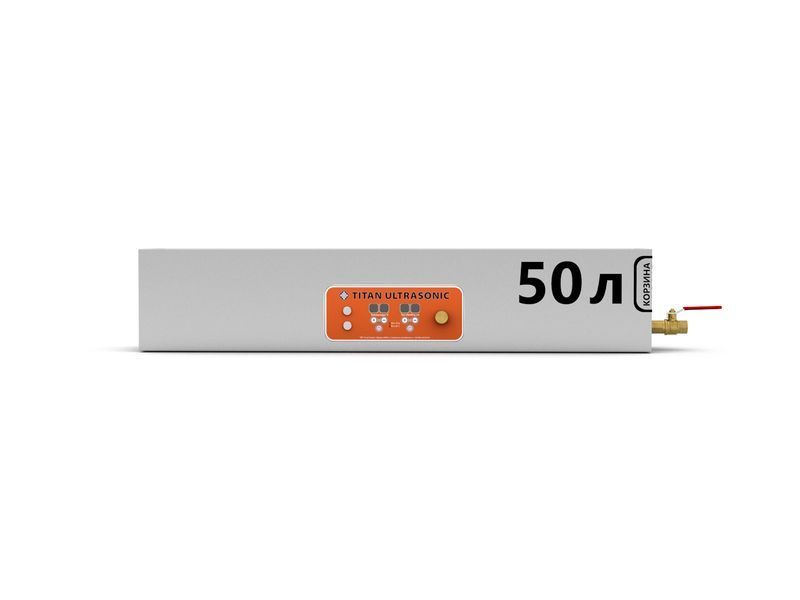
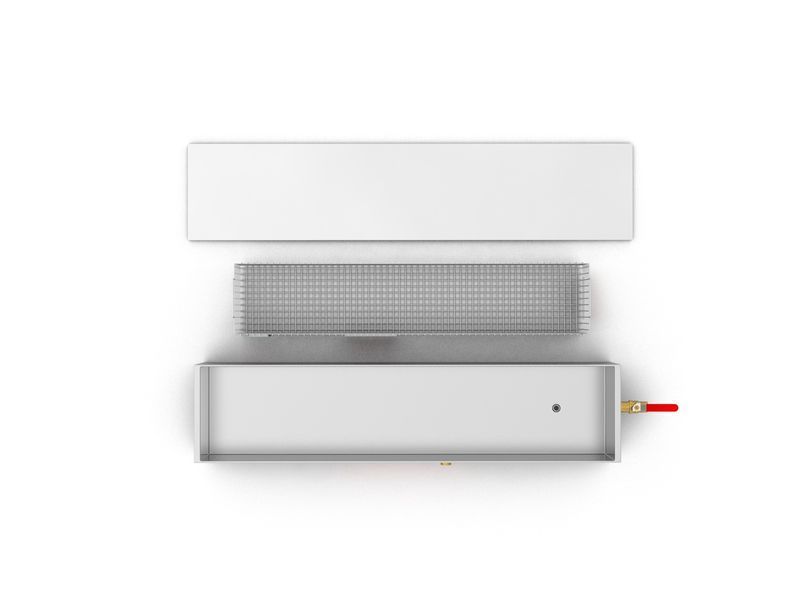
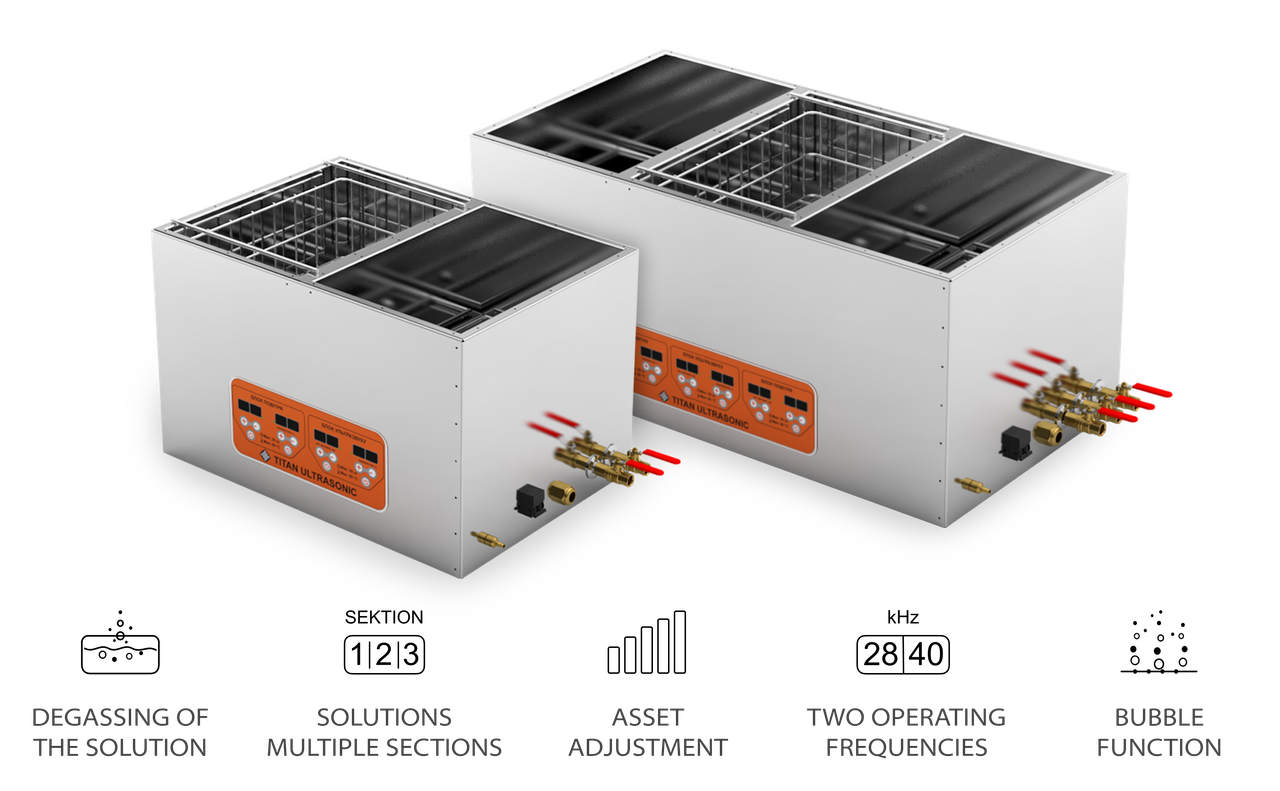
Industrial Ultrasonic Cleaner TUS-16PR3214 for Cleaning Large Batches of Parts in Workshops and Manufacturing Facilities
How to Choose the Right Industrial Ultrasonic Cleaner Without Making a Mistake
[ AnchorBanner1 ]
Why the Manufacturer Matters in Industry
When you are looking for an industrial ultrasonic cleaner, you are choosing not just a “large tank,” but a key element in the production chain, one that affects lead times, cost, and the stability of the entire operation.
Here, what matters is not how many liters are in the specification sheet, but who designed the equipment, what its real service life is, and how it behaves in multi-shift operation.
In practice, this is a choice between investing in a proven system with clear service support or buying an anonymous large tank without a real usage history and proper support. In the first case, you control the process; in the second, you are constantly playing a lottery.
In the industrial segment, it is especially clear that systems with similar outward design can differ significantly in configuration, power, reliability, and automation level.
Saving on the manufacturer’s engineering, steel quality, and electronics always comes back as downtime, emergency repairs, and defective output.
That is why the main selection criterion is a combination of factors: the manufacturer’s experience, completed projects, a high degree of adaptation to your specific tasks, and a willingness to take responsibility for cleaning results throughout the entire service life.
What to Pay Attention to When Choosing an Industrial Cleaner
Power Density and Tank Geometry
For industrial tanks, power density becomes critical. It is not enough to simply “fill a large tank with ultrasound” — you must ensure uniform cavitation throughout the entire volume, including the area with the highest load of parts.
If you take two 500-liter tanks with the same form factor, but one has 10 kW of ultrasound and the other 20 kW, then formally these are “two identical industrial cleaners.” In practice, these tanks have power densities of 20 W/L versus 40 W/L — the difference in cleaning quality and speed will be enormous, especially with a fully loaded basket and in continuous flow operation.
Practice shows that serious industrial cleaning is provided by tanks from 25–30 W/L, the optimal range is 30–35 W/L, and 40 W/L and above already delivers confident performance with the toughest contaminants and no compromises.
It is the combination of volume, power, and correct emitter layout that determines whether the system will really perform shift after shift.
The Cleaner’s Place in the Technological Chain
To choose an industrial unit, you need to clearly define:
- How clean do you want the part to be, and at what point in the technological chain will the cleaner be installed?
- What sequence of cleaning stages is required in your process?
- For which operations do you need to ensure the next cleaning stages? (preliminary cleaning before machining, in-process washing, surface preparation for painting, galvanizing, or final cleaning before assembly)
The answers determine the required volume, the type and number of sections, the solution replacement frequency, and the required set of options:
Power control
2 frequencies
Degassing
Bubble aeration
Filtration
Oil separator
Lifting and rotary mechanisms
Lid with gas struts
Automated loading and unloading
It is important to look not at abstract “liters and kilowatts,” but at the specifics: how drainage and filtration are arranged, whether modernization is possible, temperature and time control, dry-run protection, degassing mode, and dual-frequency operation. All of this determines not only cleaning quality, but also real operating costs.
[ AnchorVideo1 ]
Questions to Ask the Manufacturer Before Purchase
Three key questions:
- Where are such systems already operating, and in what mode? Ask for examples of completed projects: the industry, tank volume, loading mode, how many years the cleaner has operated, and what modifications were required. Real cases and feedback from plant engineers say more than any marketing formula.
- How is service organized, and how long will the line be stopped in a typical failure? Find out whether there is a service center in Ukraine, whether there is a stock of key components (emitters, boards, heaters, pumps), and what the real response times are for industrial facilities. For a serious manufacturer, the norm is repairing a typical fault in a few days, not waiting weeks for spare parts. An honest and specific answer to this question about timing and cost very clearly shows the manufacturer’s level.
- What set of options is needed specifically for your process?
Describe your cycle: maximum part size, type of contamination, required cleaning level, and planned batch volume. An important sign is how deeply the manufacturer understands the details and whether they offer solutions for line layout, chemistry selection, and operating modes — or simply sell a “standard tank” without adapting it to your production.
Ukrainian Manufacturer for Industrial Tasks
Why “Titan Techniks”
“Titan Techniks” is a manufacturer that builds systems around your technological tasks rather than selling ready-made boxes under keyword-driven product names. The Titan Ultrasonic engineering team designs and manufactures industrial tanks and multi-stage lines with real Ukrainian workshop conditions in mind: heavy contamination, unstable power supply, limited space, and strict safety requirements.
Each industrial cleaner is a project: from selecting the tank volume and configuration to designing fixtures, adjusting operating modes, and commissioning on site. For the production owner, this means not just equipment delivery, but a partnership: help integrating the system into an existing line, staff training, fast service, and the ability to upgrade as the workload grows.
How Ultrasonic Cleaning Works
Principle of Ultrasonic Cavitation
The operating principle of an ultrasonic cleaner is based on acoustic cavitation. The ultrasonic emitter transmits vibrations at a frequency of 28,000 or 40,000 times per second to piezoelectric transducers, which create alternating high- and low-pressure zones in the working solution.
In the low-pressure zones, billions of microscopic bubbles are formed. When they collapse, each one produces a micro-impact with local pressure on the part’s surface of up to 1,000 atmospheres and a temperature jump of up to 5,000 °C — enough to literally “knock off” contaminants from any surface.
The key advantage is volumetric cleaning of the part, not just treatment of accessible surfaces. As a result, the working solution penetrates threaded connections, closed channels, capillary gaps, and porous areas.
Oil, soot, flux, biological deposits, and corrosion residues are removed without harsh mechanical action, which is critical for precision fits, coatings, and delicate components.
Classification of Titan Techniks Ultrasonic Cleaners
The Titan Ultrasonic line is designed to cover the entire customer journey: from a single semi-industrial cleaner to a fully automated multi-stage line for a large factory.
Semi-Industrial Ultrasonic Cleaners
Titan Techniks semi-industrial models are designed for daily operation in service centers, clinics, and workshops. These are tanks from 3 to 100 liters with a 40 kHz frequency, genuine power density, heating, timer, LCD display, and, when needed, degassing, power control, and dual-frequency operation. They are chosen where professional results are needed without a large unit size or high energy consumption.
Industrial Ultrasonic Cleaners
Titan Ultrasonic industrial cleaners are the heavy-duty class: volumes from 30 to 10,000+ liters, reinforced SS304 / SS316 stainless-steel bodies, higher ultrasonic power, and expanded functionality. Dual-frequency 28/40 kHz solutions, bubble aeration, filtration, oil separators, lifting tables, and rotary mechanisms — everything for continuous operation in workshops and production facilities. These systems are designed for serious contamination — soot, oil, technological residues — and multi-shift operation.
Multi-Stage Ultrasonic Lines
Titan Techniks multi-stage ultrasonic cleaners are a level where ultrasound stops being a separate operation and becomes part of a fully structured process line. Several tanks are combined into one system where degreasing, ultrasonic cleaning at one or two frequencies, rinsing, passivation, and final washing are carried out in sequence.
Compact solutions are suitable for laboratories and small-batch production, while large systems up to 10,000 liters make it possible to organize conveyor-based processing of batches with defined throughput and repeatability. This format is for those who need guaranteed cleanliness with large volumes and strict quality requirements.
Additional Functions of Industrial Tanks
Bubble Aeration
Bubble aeration is air injection from below through perforated pipes, creating intensive circulation of the solution and helping remove loose contaminants from the part surface more quickly. In combination with ultrasound, this increases cleaning speed and reduces the risk of stagnant zones in large tanks.
Filtration and Oil Separators
Filtration systems and oil separators remove contamination from the circuit, extending solution life and protecting emitters and heaters from deposits. This is especially important in workshops with high daily load, where downtime for draining, washing, and refilling the tank directly affects productivity.
Lifting and Rotary Mechanisms
Lifting tables, traverses, and rotary baskets simplify work with heavy and bulky parts, ensure uniform cavitation access to all surfaces, and reduce the risk of operator injury. Movement of the part relative to the ultrasonic field helps eliminate “shadow zones” and balance the result across the entire batch.
Dual Frequency (28/40 kHz dual-frequency mode)
The dual-frequency mode allows switching between 28 and 40 kHz depending on the task. The lower 28 kHz frequency provides aggressive cavitation with larger bubbles — effective for soot, machine oil, and heavy deposits on metal parts. The higher 40 kHz frequency works more gently and precisely — important for coated parts, precision assemblies, and non-ferrous metal components.
Power adjustment allows the same tank to be adapted to different product types and loading conditions: reduce intensity for delicate surfaces or small batches, or raise it to maximum when working with large batches or difficult contamination. This increases the system’s versatility and allows more precise energy management in production.
Degassing is a preparatory mode that starts before the main cleaning cycle. In 5–10 minutes, degassing removes air bubbles from the liquid and strips the air film from the part’s surface. As a result, cavitation activity increases by 20–30%, the solution works evenly across the entire surface, and you get a cleaner result in less time.
Which Functions Do Professionals Choose?
Our clients’ experience has shown that combining several functions has become a necessary setup for high-quality industrial cleaning.
Deep Clean (Degassing + 2 frequencies)
For production sites where perfect and uniform cleaning is required, with two-stage processing at low and high frequencies. In demand in instrument making, aerospace, and medical industries.
For machine building and heavy industry, where aggressive cleaning of difficult contaminants must be combined with a gentle mode for parts requiring special processing conditions.
For electronics production and precision component manufacturing: remove air from the solution for maximum cavitation efficiency and precisely adjust intensity for different products and coatings.
Can perfect industrial cleaning be achieved without compromise? Yes — that is what the Full Control series was developed for.
(Degassing, 2 frequencies, power adjustment)
It guarantees maximum productivity and stable results in any multi-shift operating mode. This is a flawless solution for industrial cleaning of any products — from precision parts to large assemblies with heavy contamination. An ideal choice for machine building, defense, aerospace, and energy industries.
[ AnchorVideo2 ]
Industrial Cleaner Applications
Industrial ultrasonic cleaners are used where volume, contamination, and operating mode go beyond the capabilities of semi-industrial solutions.
Machine Building and Heavy Industry
Cleaning housings, blocks, covers, gears, shafts, hydraulic and pneumatic distributors, transmission units, and powertrain components before inspection, assembly, painting, or heat treatment. Ultrasound effectively removes oil, emulsions, soot, and abrasive residues, penetrating channels of complex shape and internal cavities that spray washing cannot reach.
Auto Components and Large Assembly Repair
Cleaning engine blocks, cylinder heads, automatic transmission and CVT housings, torque converters, valve bodies, and oil pans, where there are many hidden channels and threaded connections. Industrial tanks make it possible to process both individual parts and complete assemblies on special hangers or in large baskets.
Metalworking and Surface Preparation for Coatings
Removing cutting fluids, preservative greases, abrasives, and corrosion products after turning, milling, grinding, and galvanic processing. Ultrasonic cleaning is a mandatory stage before applying paint and electroplated coatings when absolute surface cleanliness is critical.
Electronics and Instrument Manufacturing
Cleaning boards, modules, housings, and precision components in serial production where high throughput must be combined with a gentle process. Multi-stage lines make it possible to build a complete cycle: degreasing, ultrasonic cleaning at one or two frequencies, rinsing in demineralized water, and final drying.
Aerospace, Energy, and Defense Industries
Processing critical parts where cleanliness directly affects service life and safety: fuel and hydraulic system components, turbine assemblies, precision mechanisms. Here, tank capabilities, process traceability, and a full package of safety and sanitary documentation are essential.
Fuel Equipment Repair and Diesel Service
Industrial cleaning of injectors, unit injectors, high-pressure pumps, nozzles, and hydraulic blocks under high workload. Ultrasound removes varnish deposits and soot from precision channels without damaging seating surfaces, cutting disassembly and washing time by several times.
Why a Ukrainian Manufacturer Matters
Problems with Anonymous Industrial Tanks
Large tanks of unknown origin, imported in one-off batches, often look attractive in price. But in industrial use, issues quickly appear: understated real power, thin tank steel, and the absence of proper service and spare parts. At volumes of hundreds of liters and dozens of cycles per day, this quickly becomes a problem.
Any stoppage of the cleaning process is not just a possible repair, but a stoppage of the entire production chain: missed deadlines, cleanliness-related defects, and the need to urgently find a replacement. As a result, initial savings turn into a multiple increase in operating costs and product cost.
What Titan Ultrasonic Offers as a Ukrainian Manufacturer
Titan Techniks, as a Ukrainian manufacturer, offers real rather than nominal 30–40 W/L performance, SS304 / SS316 stainless-steel tanks, a full set of documents, and the necessary certificates for industrial implementation. The service department and stock of key components inside the country reduce repair times from months to just a few days.
Titan Ultrasonic (LLC “Titan Techniks”)
Titan Ultrasonic (LLC “Titan Techniks”) is a Ukrainian manufacturer with a full production cycle, its own R&D, and a service center in Zaporizhzhia:
- SS304 / SS316 stainless steel bodies
- Real, not nominal, power
- Warranty and service within the country
- Design and manufacture to individual order
- Integration into existing production lines
Frequently Asked Questions
What cleaning agents are used in industrial tanks?
For industrial systems, specialized concentrates Titan Cleaner are used, selected according to the type of contamination and the material of the parts. As a rule, these are water-based alkaline or neutral formulations compatible with ultrasound and safe for the alloys and coatings used. Using plain water without a concentrate is an inefficient use of the equipment and reduces tank service life.
What is the service life of an industrial unit?
The service life of industrial piezoelectric transducers under correct operation is designed for multi-shift use: the system maintains working power for years, and individual emitters and heaters can be replaced during scheduled maintenance. All of these operations are available inside the country, which eliminates long downtime. The industrial series comes with a 12-month warranty and post-warranty service.
How do Titan Techniks industrial cleaners differ from anonymous analogues?
With anonymous tanks, nominal and real parameters often differ: actual working power is about 10–15 W/L, while Titan Techniks industrial cleaners deliver a guaranteed 30–40 W/L. Anonymous models usually have thin stainless-steel bodies, while Titan Techniks tanks are built from SS304 / SS316 steel with a reinforced frame. In addition, there are the necessary certificates, full documentation, and service and spare parts in Ukraine.
How do you choose the volume and configuration of an industrial tank?
You should start from the dimensions of the parts, the daily and shift processing volume, and the required line throughput. The tank is selected according to product size, taking into account fixtures, baskets, or hangers and the technological clearance around the perimeter.
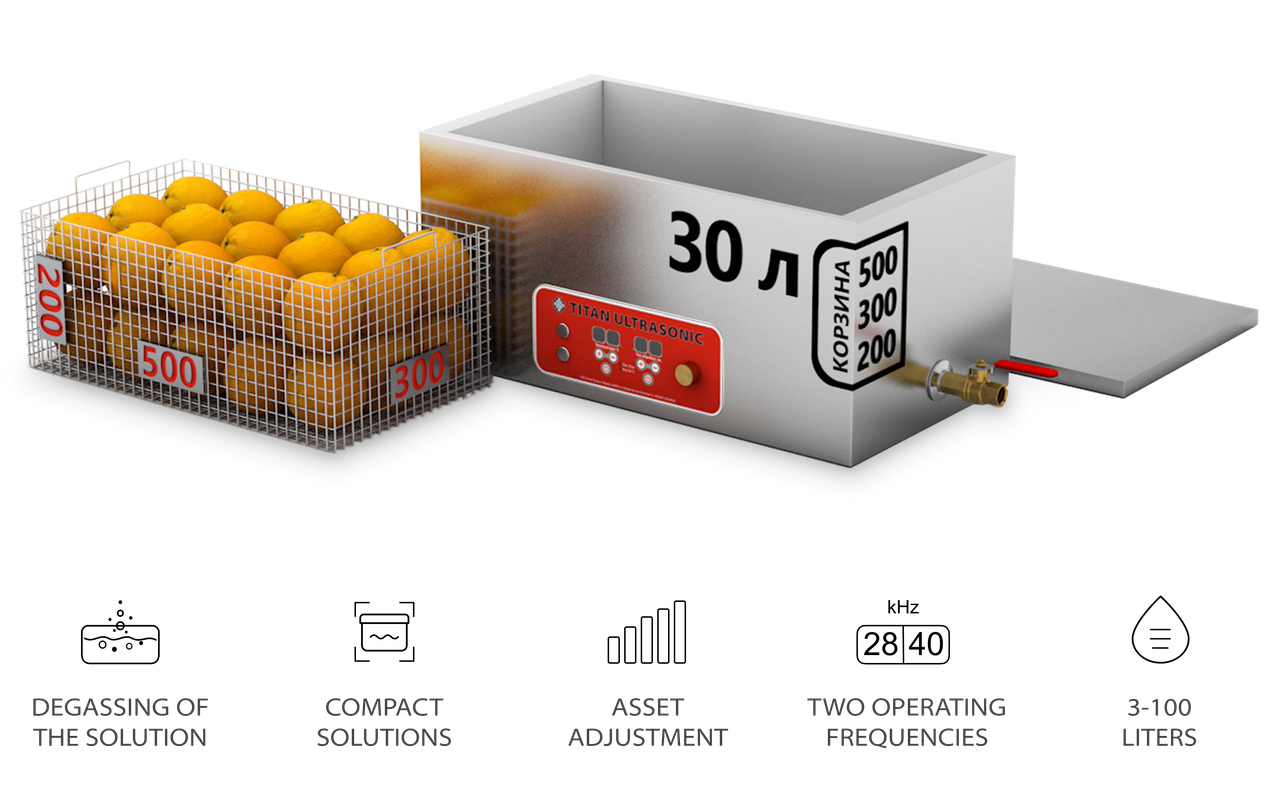
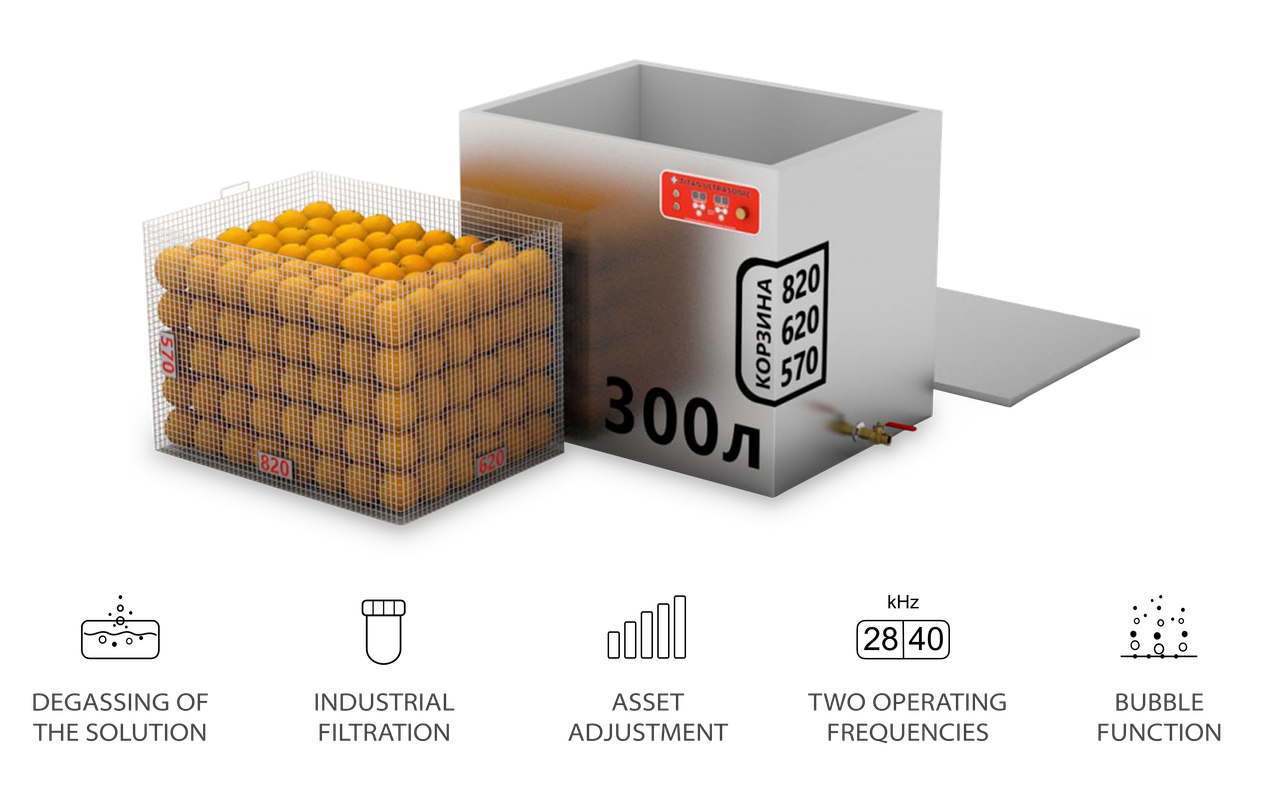
🍊
We measured the basket in oranges — and it works better than any table.
Yes, not in millimeters, but in oranges.
Because an orange is something you have definitely held in your hand and you know its size well.
Honestly, numbers like “470 × 270 × 180 mm” do not mean much to the imagination.
An orange gives a real scale that is immediately understandable to everyone.
One look at the photo — no mental ruler needed, and you can instantly see whether your part will fit.
Can an industrial cleaner be integrated into an existing line?
Yes. Titan Ultrasonic industrial tanks can be supplied either as standalone units or as part of multi-stage lines with loading automation, conveyors, and integration into the workshop control system. During the design stage, available space, part logistics, and throughput requirements are taken into account.
Technical Specifications
| Name |
Industrial Ultrasonic Cleaner |
| Manufacturer |
Titan Technics |
| Equipment Type |
Industrial Ultrasonic Cleaners |
| Series |
Power Control |
| Ultrasonic Cleaning Power (W) |
480 |
| Heating Power (W) |
1000 |
| Basket Length (mm) |
320 |
| Basket Width (mm) |
140 |
| Basket Height (mm) |
300 |
| Volume (L) |
16 |
| Tank Length (mm) |
330 |
| Tank Width (mm) |
150 |
| Tank Height (mm) |
300 |
| Power Adjustment |
Yes |
| Degassing (Pulse Mode) |
No |
| 28/40 (Frequency) |
No |
| Operating Frequency (kHz) |
40 |
| Additional Frequency (kHz) |
None |
| Sweep Function |
No |
| Heating Temperature |
20 - 80 °C |
| Timer |
Yes |
| Power Supply |
220 V, 50/60 Hz |
| Equipment Material |
Stainless Steel SS304, SS316 |
| Weight (kg) |
25 |
| Warranty, months |